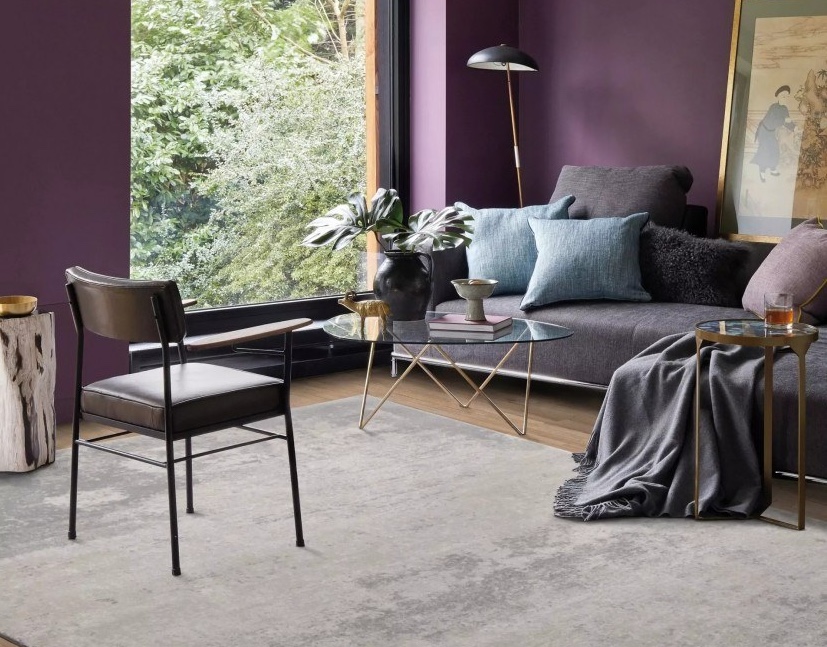
Most changes to a home begin with renovation, and with weeks when the living room is out of use. A rug is the exception. It can be chosen and carried home in a single day, without changing the floor or touching the walls, yet the room afterwards looks and sounds different. In October, when the evenings grow longer and a home calls for more warmth, this is the simplest step there is.
Hard floors such as parquet, vinyl or tiles are practical, but the first step onto them in the morning is cool. A wool rug changes that: wool is a natural fibre, warm and pleasant to the touch, which is why it suits living rooms and bedrooms above all. A rug on both sides of the bed is a small difference, but one you feel every morning; in the living room it is the place where children sit on the floor and where, in the evening, you want to be barefoot.
Warmth underfoot is also the reason a rug in a home is a deliberate choice, not a compromise. It is neither the most hard-wearing nor the most moisture-resistant floor covering. Its value is comfort.
Hard floors reflect sound. A rug absorbs it - wool fibre naturally dampens noise, softens footsteps and reduces echo. In practice, the same room with a rug under the seating group sounds calmer, and that is felt both by the people in it and by the neighbours below.
This is also the answer to why a rug is worth considering even in a home where a quality hard floor has been laid throughout: a rug is not an alternative to the floor, but an addition to it wherever quiet and comfort matter.
In an open-plan space, where the kitchen, dining table and sofa share one room, a rug does what a wall would otherwise do - it marks where the relaxation zone begins and ends. For that to work, the rug has to be in proportion to the furniture group, not "floating" in the middle of the room:
by the sofa, the rug should reach at least under the front legs of the furniture - in a living room that usually means a size from 160x230 cm;
under a dining table, the rug should be large enough that the chairs stay on it even when pushed back;
a round rug works as an accent - under a round table, in a reading corner or in the hallway.
A rug that is too small visually fragments the room. In the right size, it helps the furniture group read as one element of the interior. That is why size is the first thing worth deciding — before colour and pattern.
A rug is the largest field of colour in a room after the walls, and it changes the mood of a space more than any other accessory. The practical side: light, plain rugs will need cleaning more often, while a rug with an organic or geometric pattern hides everyday dirt and minor signs of wear better. Two rugs with identical technical specifications but different colour and pattern can serve for very different lengths of time.
Bear in mind that a rug's tone cannot be judged from a picture on a screen. It is often hard to judge from a small piece, or even in a showroom. The same beige or graphite looks different in daylight and in a room with warm lighting, and with a rug of 200x300 cm a mistake is expensive. Tone and texture should be seen on a large sample in natural light. Best of all is the chance to "try on" the rug in the room where it will live.
A quality wool rug is not unhygienic and is not "hard to look after" - problems usually arise only when regular care is neglected. Day to day, vacuuming without a rotating brush is enough. Stains should be dealt with immediately with a damp cloth, without rubbing and without aggressive cleaning agents. Wool fibre is resilient and holds its shape well, so a regularly cared-for rug looks good for years.
A rug is rarely bought separately from the rest of the interior - it goes together with the sofa, the table, the curtains and the lighting. At DECCO CENTRS all of these decisions are in one quarter, and a rug can be matched to the furniture it will stand beside in a single visit.
In the Anitra showroom, large wool rug samples are laid out - rectangular and round, in sizes from 80x120 to 300x400 cm, including Agnella wool collections. Colour, pattern and texture can be judged in real life rather than on a screen, and the consultants help find the right proportion for a specific room. Many rugs are available in the Riga showroom immediately — the room can be warmer this very evening.
Yes. A rug does not need to be fixed to the floor; it can be laid on parquet, vinyl, laminate or tiles and moved to another room when needed. It is an addition to a hard floor, not a replacement for it.
The rug should be in proportion to the furniture group: by the sofa it should reach at least under the front legs of the furniture, which usually means a size from 160x230 cm. Under a dining table, the rug should be large enough that the chairs stay on it even when pushed back.
Wool is warm, resilient and holds its shape well, which makes it suitable for living spaces. Day to day, vacuuming without a rotating brush is enough; stains are dealt with immediately, without rubbing. A patterned rug hides everyday dirt more practically than a light, plain one.